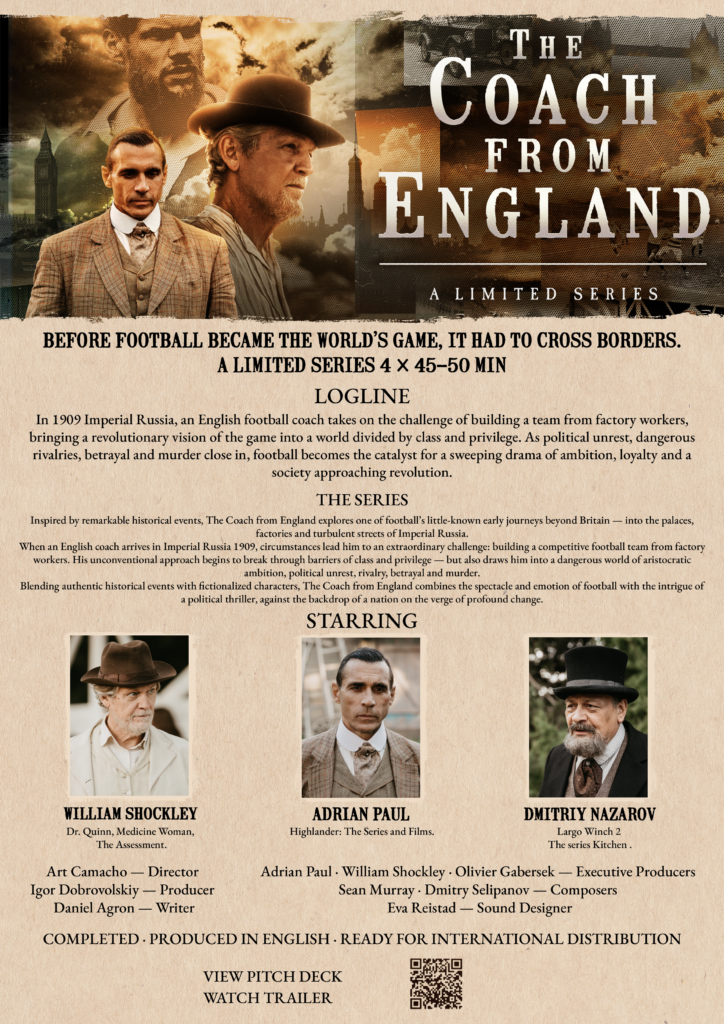
Film Production
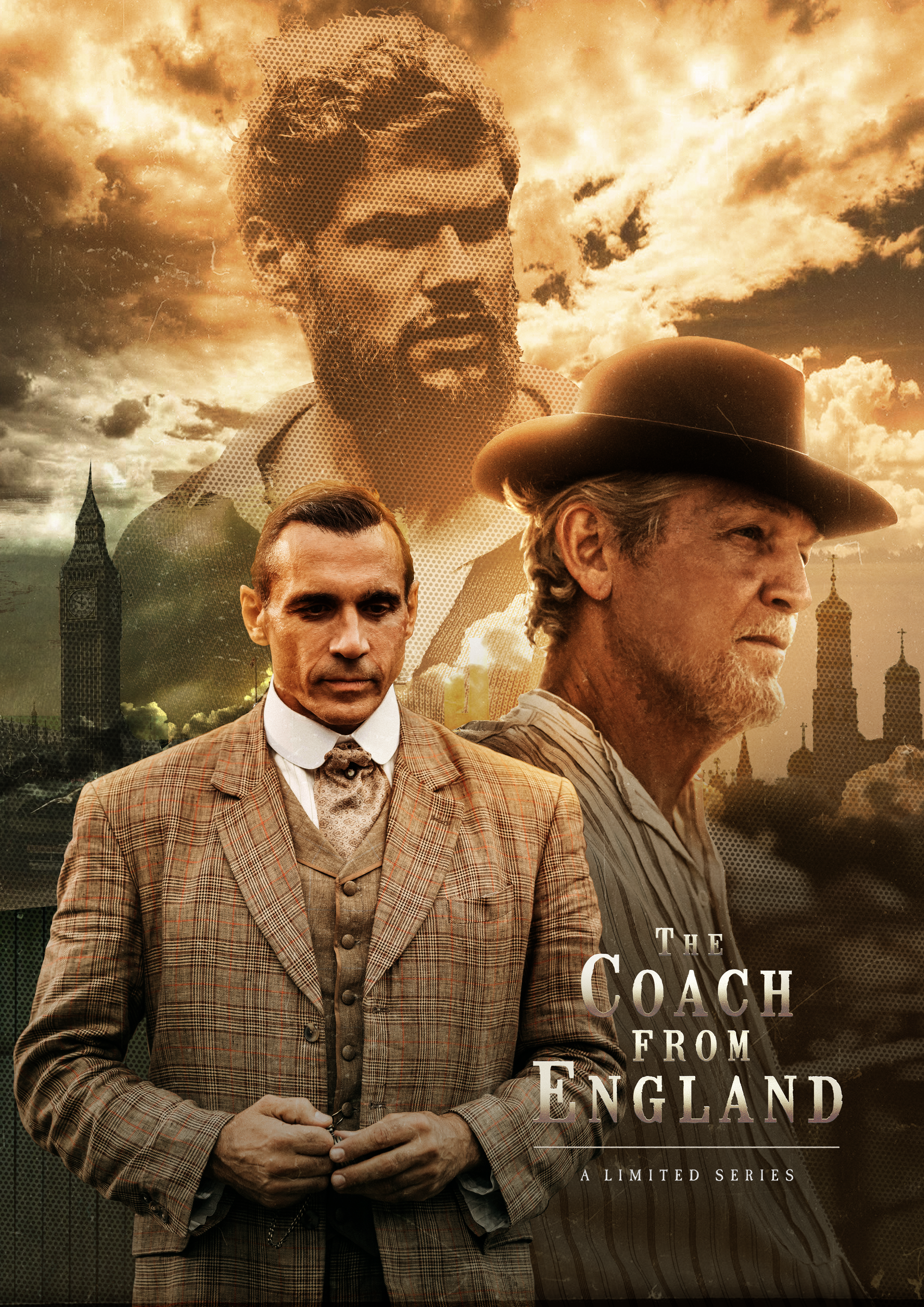
The Coach from England
Story
THE COACH FROM ENGLAND is a gripping four-part limited event series that blends underdog sports drama with gritty historical intrigue. When an idealistic English football coach arrives in a foreign industrial city chasing a dream, tragedy pulls him into a dangerous world of crime, class tension, and cultural division. Refusing to walk away, he builds a team from overlooked workers and outsiders, determined to prove that the game can unite people who share nothing — except heart.
With cinematic action, emotionally charged performances, and the uplifting spirit of Ted Lasso wrapped in the darker edge of Peaky Blinders, the series delivers high-stakes matches both on and off the field. As one final exhibition game threatens to change the fate of everyone involved, THE COACH FROM ENGLAND becomes a story about courage, loyalty, and the power of sport to ignite hope in the harshest conditions.
PRESS RELEASE
MODERNAGE CORPORATION COMPLETES PRODUCTION ON ‘THE COACH FROM ENGLAND: A LIMITED SERIES’ — AN HISTORICAL SOCCER DRAMA AVAILABLE FOR GLOBAL ACQUISITION AHEAD OF FIFA WORLD CUP 2026
The four-part premium series—described as Ted Lasso meets Peaky Blinders—is fully produced, delivery-ready, and strategically positioned for a May 2026 launch.
LOS ANGELES – January 12, 2026 — Modernage Corporation has completed principal and post-production on THE COACH FROM ENGLAND: A LIMITED SERIES, a four-part premium historical soccer drama now available for worldwide acquisition by major global streaming platforms.
Timed for a 2026 release, the series is strategically positioned to capitalize on the global surge in soccer interest leading directly into the FIFA World Cup 2026, hosted across North America.
Prestige Creative Team
The series is led by an accomplished international producing team, including Executive Producers Adrian Paul (Highlander; former professional UK footballer), William Shockley (Dr. Quinn, Medicine Woman, Showgirls), and Igor Dobrovolsky (Founder of ModernAge; producer of the global animated franchise The Fixies: Top Secret and the feature film The Wild League, longlisted for Golden Globe consideration in 2020).
Veteran action film director Art Camacho (Ruthless, The Wrecker, Dustlands) directs the series and also serves as Executive Producer, bringing a cinematic, grounded intensity to both the football matches and dramatic action.
The Story: Gritty History Meets Underdog Heart
Inspired by real historical events (with fictionalized names and dramatized scenes), THE COACH FROM ENGLAND blends the optimism and heart of Ted Lasso with the stylized grit and criminal intrigue of Peaky Blinders.
Set in early 20th-century Russia, the series follows Jones Fleming (Shockley), a passionate English football enthusiast from Blackburn who travels to Russia at the invitation of his close friend James Parker (Paul) to coach a team of British expatriates.
When Parker is brutally murdered by a ruthless criminal kingpin, Fleming is thrust into a dangerous world of corruption, cultural hostility, and social prejudice. Refusing to abandon his mission, Fleming sets out to share his love of football with the local working class.
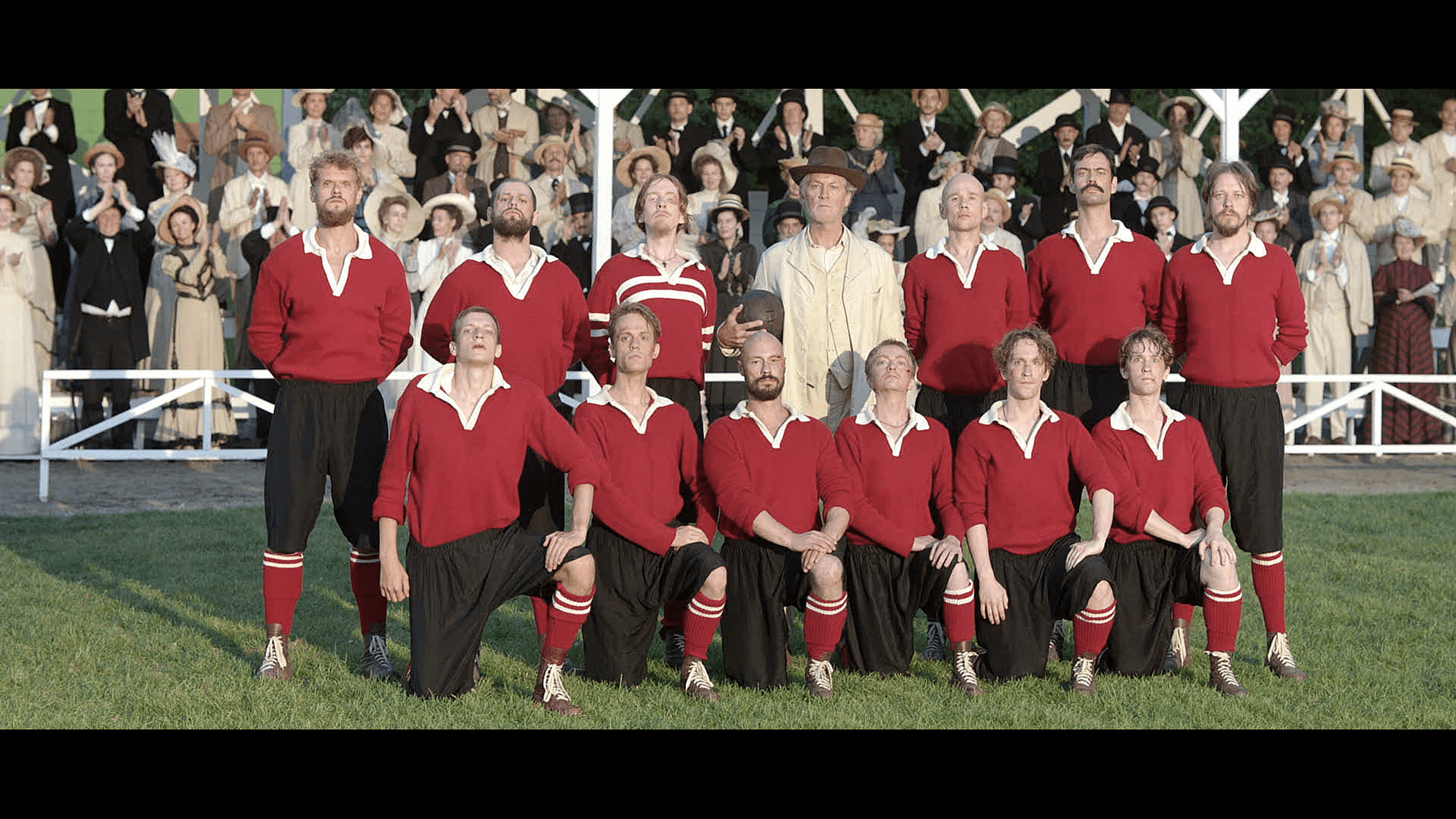
He forms a new team—the “Wild One” Team—comprised of factory workers and laborers, led by the powerful and stubborn Volga bargeman Varlam (Vladimir Yaglych). As tensions rise, factory owner Rodion Balashov (Dmitry Nazarov) makes a desperate gamble, wagering his entire factory on a single exhibition match against Russia’s elite aristocratic club, Sokolniki.
The series builds toward a climactic final match that pits the working class against privilege, turning football into a battle for dignity, survival, and identity.
The series is dedicated to the real-life British pioneers—including Blackburn Rovers supporters Harry and Clement Charnock—who introduced the game of football to Russia.
Production Scale & Craft
Written by acclaimed Israeli playwright and screenwriter Daniel Agron (The Yard, The Square), the series places equal emphasis on character, historical authenticity, and visceral realism.
- Consulting Producer: Eric Brenner (Stuck in Love, Boychoir)
- Original Score: Sean Murray (Call of Duty: Black Ops, True Crime, Buffy the Vampire Slayer)
- Filmed on authentic historical locations in Moscow
- Finished by a full Hollywood post-production team in Burbank, California
- Production scale includes up to 450 actors and extras
Availability
THE COACH FROM ENGLAND: A LIMITED SERIES is fully produced, delivery-ready, and currently available for global distribution.
SERIES DETAILS
- Title: The Coach from England: A Limited Series
- Genre: Historical Sports Drama
- Format: Four-Part Limited Series (4 × 45 minutes)
- Budget: High-Seven-Figure
- Director: Art Camacho
- Writer: Daniel Agron
- Executive Producers: Adrian Paul, William Shockley, Igor Dobrovolsky, Art Camacho
- Key Cast: William Shockley, Adrian Paul, Vladimir Yaglych, Dmitry Nazarov
- Status: All Episodes Produced & Ready for Distribution
Winning Awards
View Pitch Deck The Coach from England
Cast/Crew
Director
- Art Camach
Produced by
- ModernAge Corporation
Executive Producers
- Igor Dobrovolsky
- William Shockley
- Adrian Paul
Cast
- William Shockley
- Adrian Paul
- Vladimir Yaglych
- Dmitriy Nazarov
- Evgeniy Korakovsky
- Olesya Sudzilovskaya
- Adelina Gizatullina
- David Fisher
Partners




Behind the scene
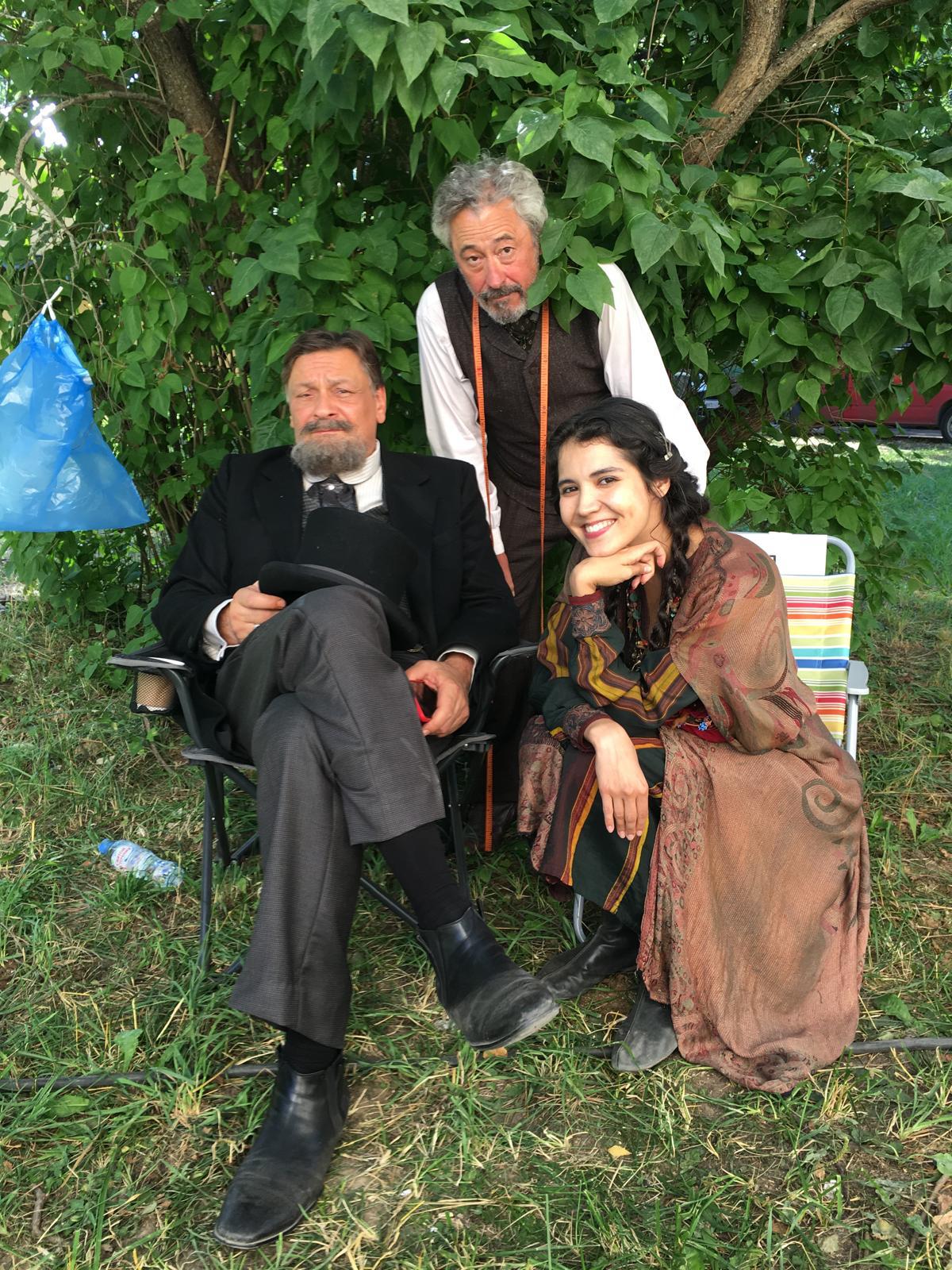

INTERVIEW QUESTIONS FOR ART CAMACHO:
‘THE COACH FROM ENGLAND’
From the outset, I was drawn to the script because of its strength of character. Every role was fully realized on the page, and that depth carried through into the performances. I was fortunate to work with an exceptional cast—some of the best actors I’ve collaborated with—who brought a profound understanding of nuance, motivation, and emotional truth to their roles. They consistently elevated the material, adding layers beyond what was written.
As the director, this allowed me to take on more of a guiding and observational role, trusting the actors to inhabit their characters fully while shaping the overall journey. The story unfolds across an intense and perilous period, and the emotional arc of the characters gives the film an epic quality despite its grounded setting.
Equally vital was the crew—an extraordinarily diligent and creative crew who helped me bring the vision to life. The challenge I had was weaving a delicate balance between grit, intrigue, and violence, while never losing sight of the emotional core. At the heart of the film is a relationship
built on mentorship and trust between a coach and his star player. That Universal bond carries the story, and once it was firmly in place, everything else naturally aligned around it. I saw this movie twofold; a fish out of water love story complemented by a story of mentorship wrapped
around the perilous 1900’s Moscow.
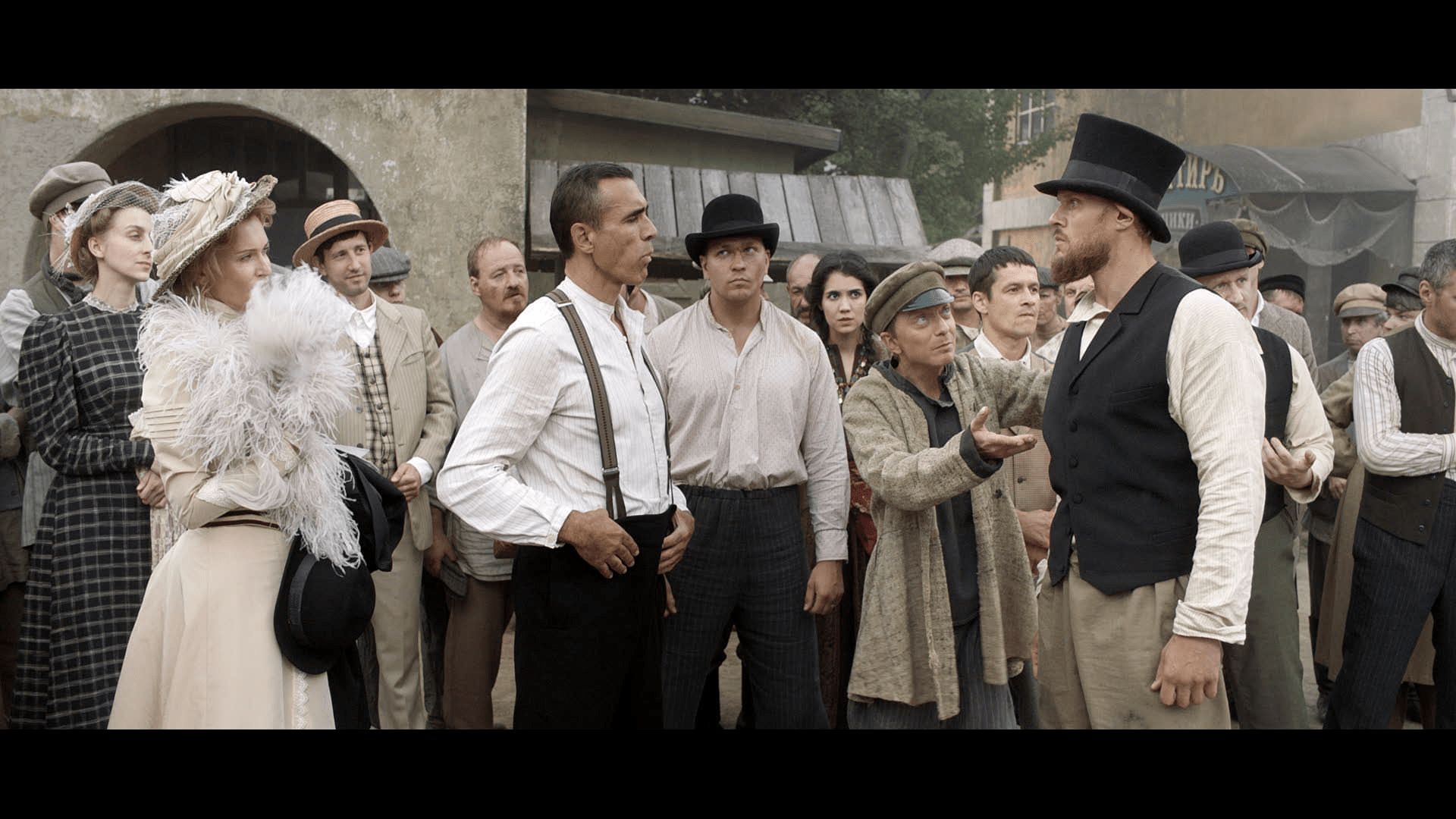
Peaky Blinders was an inspiration in terms of committing fully to a stylized visual language, but for The coach from England we wanted to create something that felt organic to its world rather than derivative. The key was contrast—both visually and thematically—between the aristocratic sphere and the criminal underworld of Khitrovka Market. It helped that the locations and sets were so authentic and immersive. We didn’t’ have to rely on green screen or any other technology to achieve the look I wanted.
For the aristocratic world, we leaned into controlled compositions, steadier camera movement,
and a more restrained color palette. The lighting is cleaner and often emphasizes symmetry and
order. Camera movement there is deliberate and composed.
Khitrovka Market, by contrast, was designed to feel raw, alive, and unpredictable. We used a more fluid camera style—to immerse the audience in the chaos of that environment. The color The Coach from England Interview: Art Camacho’s palette shifts toward dirtier, earthier tones. The frame feels more crowded, reflecting a world driven by survival rather than control.
We focused on creating a look and shooting style that supported the story’s central tension: order versus chaos, privilege versus survival. As the narrative progresses and those worlds begin to collide, the visual distinctions intentionally start to blur, signaling that no one remains untouched by the underworld once they step into it.
My background in action and stunt choreography absolutely informed the way I approached the dramatic material, but not in the way you might expect. At its core, action is about storytelling — rhythm, intention, and emotional stakes. Those same principles apply just as strongly to intimate, character-driven scenes.
When I choreograph a fight, I’m not just thinking about movement; I’m thinking about subtext, and how the emotional state of the characters evolves beat by beat. I approached the drama in much the same way. Every scene has a rhythm, a build, a release — just like an action sequence — but expressed through words, silence, performance, and movement rather than physical violence.
I was very conscious of not over-directing the drama. I focused on listening to the actors, to the moment, and to what the scene needed emotionally. So while the drama wasn’t staged like action, it was shaped with the same sense. Both rely on timing, control, and knowing when to
push forward and when to pull back. In that sense, my action background gave me a strong framework for honoring it.
Football is fast, physical, and chaotic, but if you simply replicate that chaos onscreen, you lose narrative focus. So the challenge was to capture the raw energy of the game while still telling a dramatic story.
We approached the matches almost like fight sequences. Every play was choreographed with intention—so that the audience could always understand the emotional stakes, not just the mechanics of the sport. Adrian and I spent time breaking down the matches beat by beat, The Coach from England Interview: Art Camacho ensuring that everything served character and story. Since he has a background in Soccer, it was a natural fit for him.
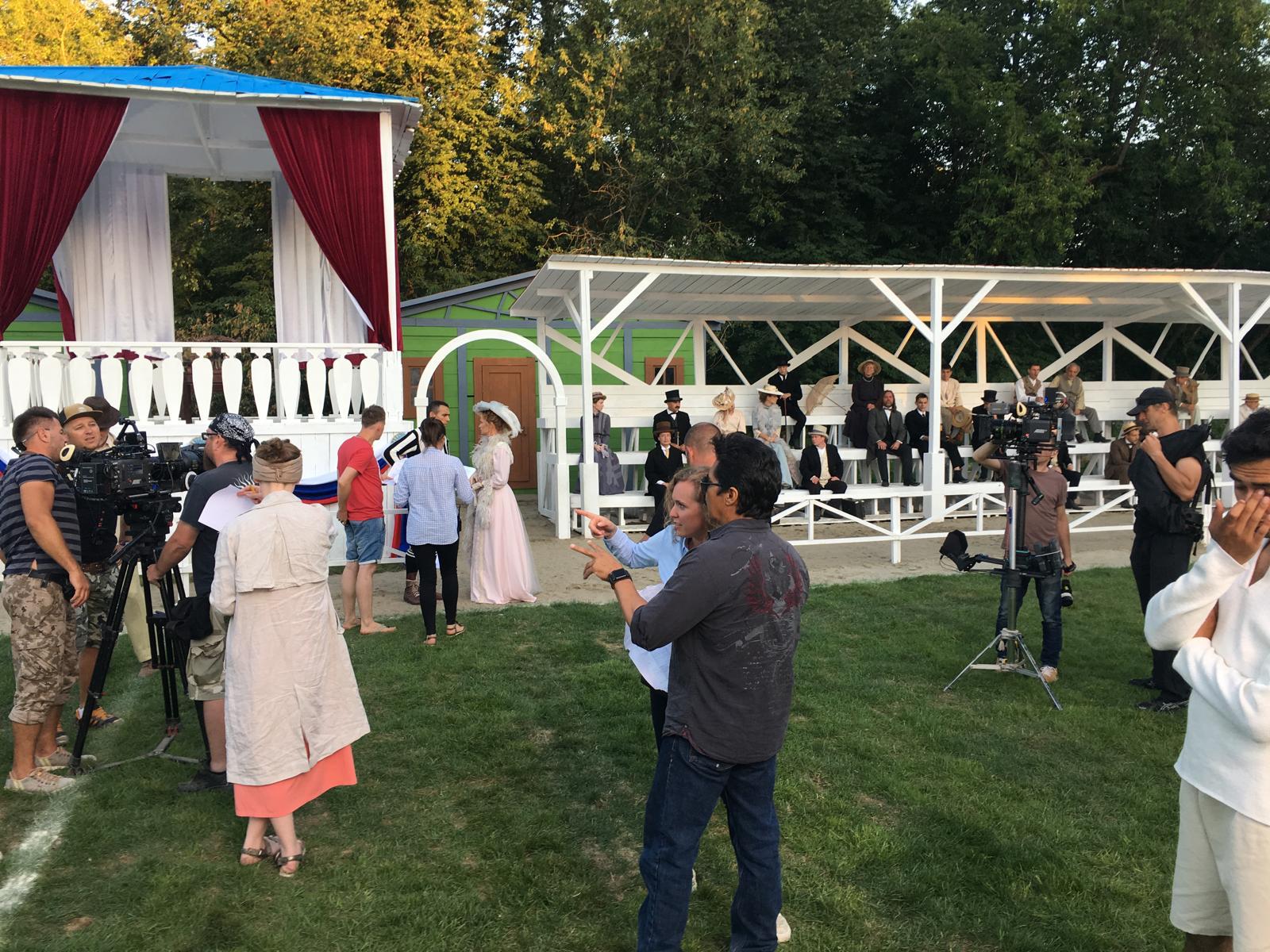
From a technical standpoint, we used a combination of handheld camera work and a dolly.
Camera placement and lens choices were carefully planned to maintain spatial clarity. We avoided overcutting; instead, we let sequences breathe so the audience could read the action and feel the consequences of each moment.
Editing rhythm was key. At critical dramatic moments, we often slowed the pace or held on performances, allowing emotion to take precedence over spectacle.
Ultimately, the matches were designed to feel lived-in and visceral, but always grounded in character. The goal was never to stage football for its own sake, but to use the game as an extension of the drama.
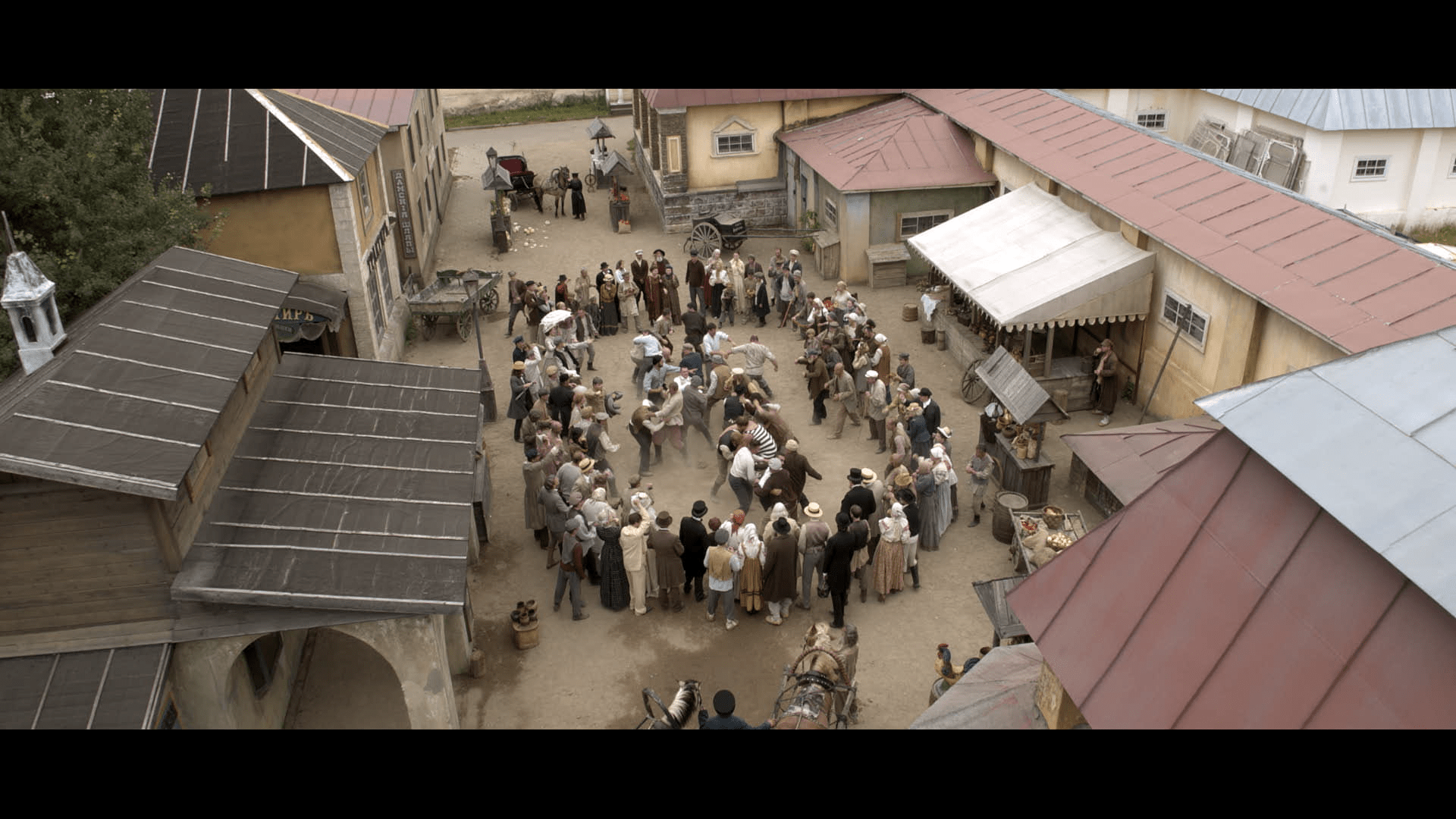
The scale of the series was exhilarating and demanding. Working with up to 450 actors and extras on any given day requires absolute discipline, clarity of vision and communication, because once you step onto period locations in a city like Moscow, there is very little margin for error.
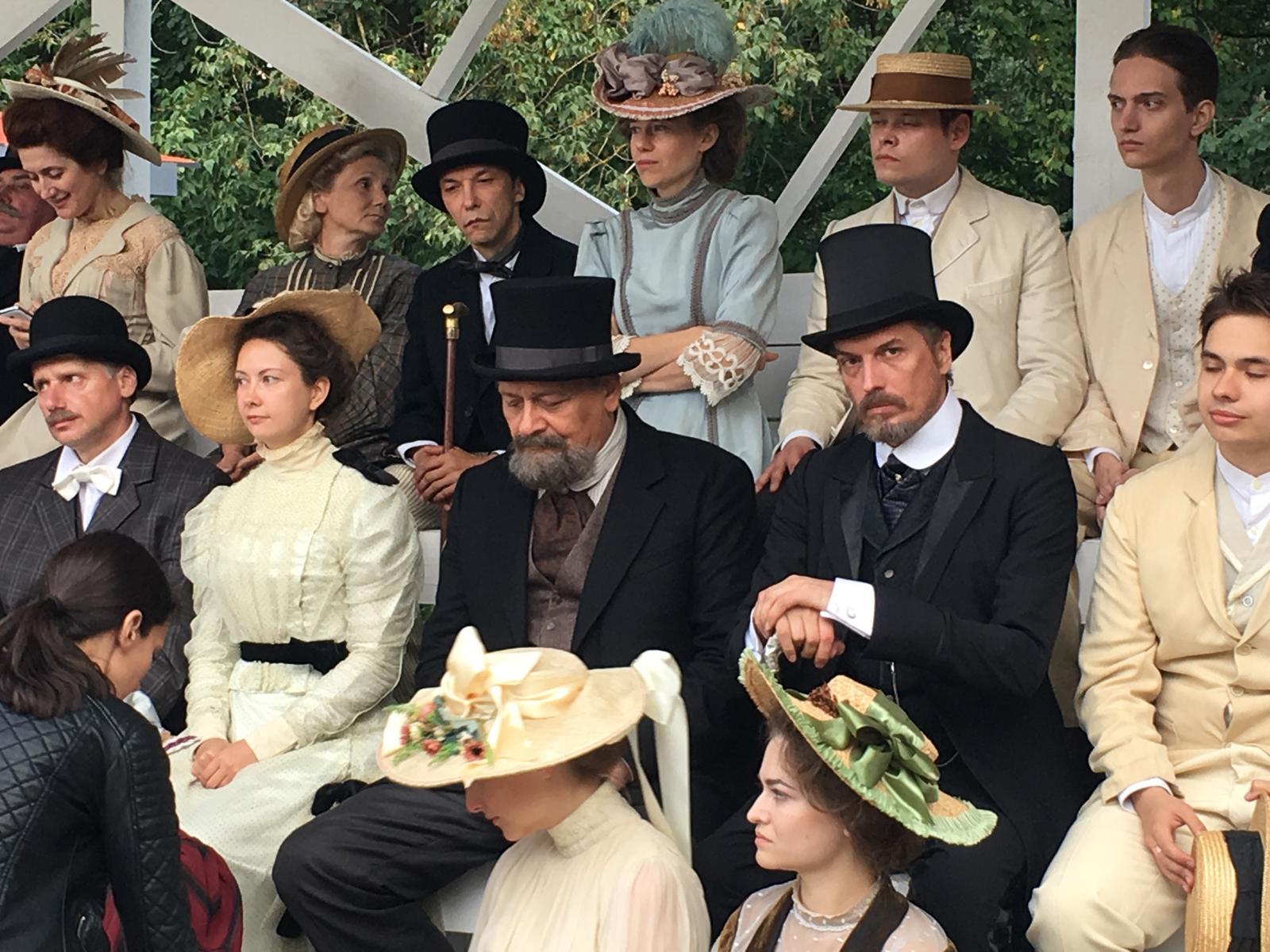
One of the biggest challenges was maintaining historical authenticity while keeping the production agile. Every background performer had to be dressed, placed, and directed in a way that felt organic to the period rather than staged. Crowd movement, behavior, and posture were all carefully guided so the frame never felt contemporary.
Filming on real historical locations in Moscow added another layer of complexity. These spaces bring immense production value, but they are often restrictive in terms of access, time, and modern infrastructure. We had to design blocking, camera movement, and crowd choreography that respected the architecture while still allowing the story to unfold cinematically. From a directorial standpoint, the challenge was focus. With that many moving parts, it’s easy for scale to overwhelm story. Ultimately, managing a production of that scale came down to preparation and having a great production team behind you.
The Coach from England Interview: Art Camacho
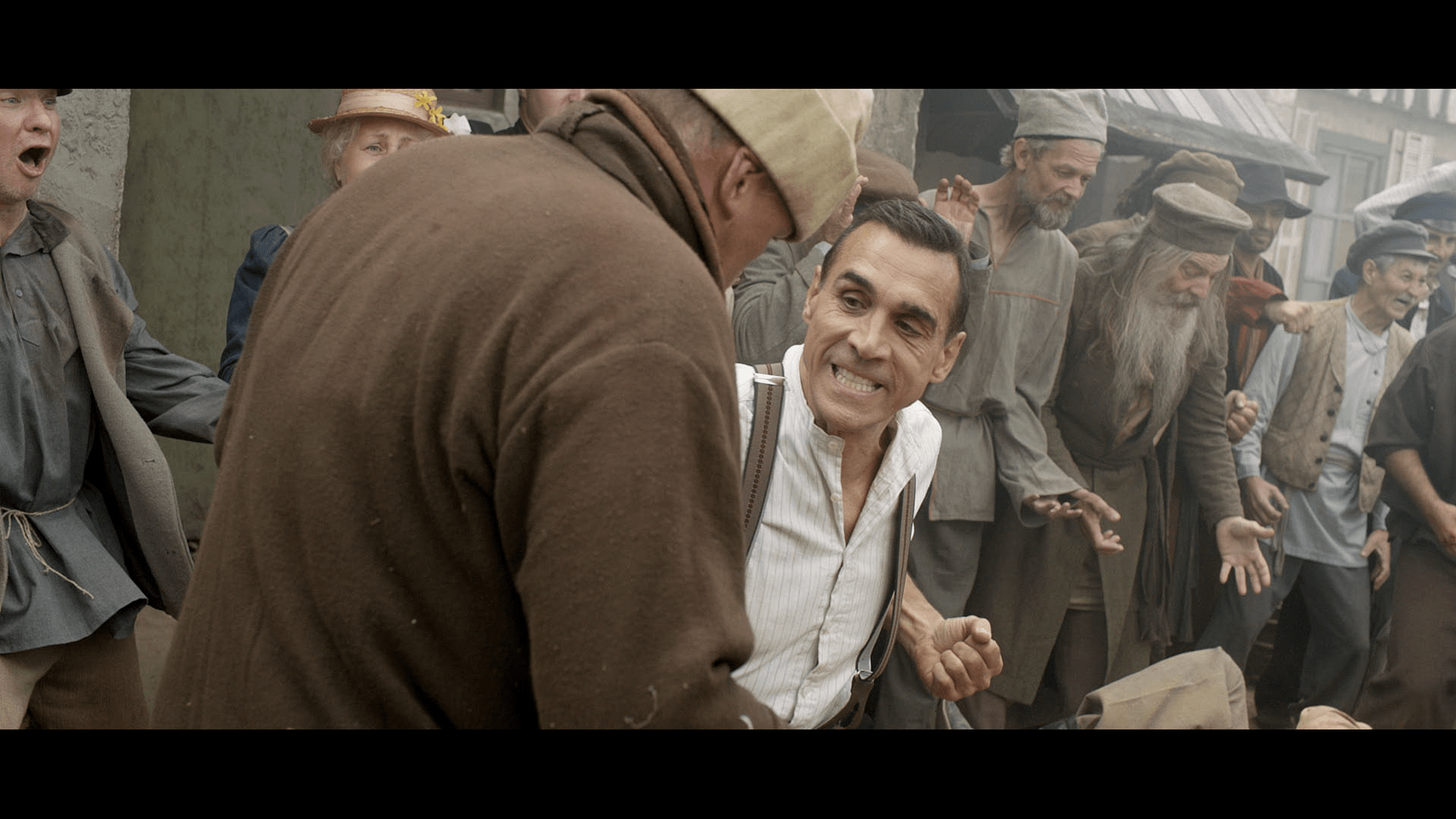
That would definitely be the confrontation in Khitrovka Market. It’s a crucial in terms of establishing the relationships at that point and introducing many of the characters who will stay with us throughout the story. It’s really about setting the groundwork—showing the dynamics, the tensions, and the alliances—so the audience understands the world and the journey ahead.
For me, it was always about grounding the stakes in the characters rather than the outcome of the game itself. We knew the audience had to feel both hope and desperation at the same time, so every directorial choice was made to keep that balance alive.
I leaned heavily into point of view of our main characters—especially in their moments of trials and tribulations. Visually, we allowed the world to feel heavier as the pressure mounted—then when the team began to believe—we let moments breathe, and allowed the performances to
carry the emotion without forcing it. Most importantly, we never treated Football as just a sporting event. It was about survival—dignity, and identity. Football became the expression of that struggle. If the audience felt the weight of what could be lost and still believed, even briefly, that victory was possible, then we knew we were doing our job.
I hope audiences walk away with a genuine sense of victory for the everyman. At its heart, The English Coach is about people who are underestimated, and written off, yet still find the courage to believe they can win against overwhelming odds.
Sport is the engine of the story, but it’s really a metaphor for something much larger—the idea that faith can create change even in the harshest circumstances. The working-class struggle is central, of course, but The Coach from England is about dignity, resilience, and the human need to fight for something that matters.
There is tragedy in the world of early 20th-century Russia, and change always comes at a cost, but what I hope lingers with the audience is hope. That feeling that even when the system is stacked against you, even when defeat feels inevitable, people can still rise, stand together, and claim a moment of triumph. That belief—that we can all win against the odds—is the emotional core of the series, and ultimately what I want viewers to carry with them when the story ends.
The Coach from England Interview: Art Camacho
From the very beginning, I knew I didn’t want wires, CGI, or anything that would soften the reality of the violence. Those early scenes—especially the traditional Russian fist fights—had to feel raw, grounded, and authentic to the time.
I wanted the choreography to reflect grit and realism—no stylized acrobatics, no exaggerated motion—just brutal, efficient violence rooted in historical fighting styles. The Russian stuntmen and the Russian Stunt and fight coordinator were exceptional in that regard. They understood how to keep the fights believable, heavy, and period-accurate, and that made all the difference.
Technically, shooting live with multiple ground cameras and a drone allowed us to capture the chaos without breaking it apart artificially. We could let the fights unfold in real time, preserving continuity and momentum, while still having coverage that kept the action clear and immersive.
Ultimately the violence feels visceral because it is visceral—performed, captured, and groundedin reality. It sets the tone early on and tells the audience that this is a world where physical conflict is harsh, dangerous, and inescapably real.
That period really was one of the best experiences of my directing career. The heart, soul, and passion of the Russian cast and crew were genuinely breathtaking. There was an incredible sense of pride in the work, and everyone—from lead actors to background performers to crew—was
fully invested in telling the story the right way. By the time we wrapped, I was honestly sad to leave Russia.
Creating that atmosphere starts with respect. Paul, Shockley, and I were very aligned in setting a tone where collaboration, trust, and enthusiasm were valued just as much as the work was. When people feel heard and appreciated, they become more vested in their work and they give more of themselves, especially on a production that demands so much physically and creatively.
The Coach from England Interview: Art Camacho
We also tried to bring a sense of joy to the work, even on the toughest days. Yes, the action was demanding and the historical detail exacting, but we never lost sight of why we were there—to make something meaningful together. That shared purpose created momentum and camaraderie.
I felt truly honored to be part of this series and this production team. It didn’t feel like just another job—it felt like a collective experience, and I think that spirit is something the audience
can feel on screen.
INTERVIEW QUESTIONS FOR WILLIAM SHOCKLEY:
‘THE COACH FROM ENGLAND’
I was excited to work on this project for many reasons. I had done a movie prior in
Moscow, so I knew how amazing the city was. And of course I was thrilled to play
“Jones Fleming”, a man past his prime who finds purpose in bringing together a group of men, destined to fail, but who achieve greatness through leadership, hard work, and sheer perseverance.
I think it is a combination of those elements. Fleming loves football – it’s his passion, his former career, yet the opportunity to introduce a new sport to a foreign country where he is a stranger, and affect change in different people’s lives, is amazingly gratifying.
Returning home would have been the easy choice, and Fleming never took the easy road. His life and career were earned, not given to him. Embracing the chaos of 1909 in Moscow was the natural fit for Fleming – the unknown, the excitement, the challenge.
Certainly the language barrier was a huge challenge. But football doesn’t necessarily require a language- it requires an understanding of the sport – It requires leadership – and Fleming was able to work his way through that maze. As for Varlam, he was a hard-headed man, but Fleming found a way to get past that – to look Varlam in the eye as an equal, and break through to common understanding and respect.
I truly enjoyed working with Vladimir Yaglych. He is such a fine actor, and fortunately for me, he speaks English, so we were able to talk and bond as actors and friends. We discovered that we both studyed the Miesner technique for acting, so there was a foundational level of understanding our craft and respecting each other’s work. In addiiton, Vladimir invited me and my wife, Tiiu Loigu, to a play that he was starring in at a theater in Moscow. It was a treat to see him perform on stage. The dynamic between us grew organically – two strong men, both with deep beliefs in who they are, coming together for a common good.
I think Fleming’s love of football – and the admiration and appreciation that he held for his players – overshadowed the surrounding elements of criminal intrigue and violence. Fleming could only control the small world that he lived in – that being football and the Russian men he was enlisted to educate and shape into players. The bigger issues outside of the sport were things that Fleming could not control- nor did he want to.
Every game and ever day carried the same weight for Fleming. Whether it was the first day of practice with the rag-tag group of Russian men that did not know a thing about football – or the final exhibition- Fleming was focused on the task at hand.
Fleming’s lasting legacy is pretty simple – he’s a man that had a true passion for football, he was excellent at his craft, and was given the chance to teach the game to a group of men that had no idea how to play the sport – and he succeded at the highest level- with dedication, compassion and leadership – the mark of any great coach.
The Coach from England has the potential to be a prestige streaming project. The rich narrative coupled with the elegant production and costume design yields a limited series that offers compelling entertainment to a wide, international audience.
Filming on location in Moscow was brilliant. The city is exquisite and the Russion cast and crew that I worked with were such wonderful, hard working, kind people. To experience Moscow with Igor Dobrovolsky was a gift that I will always treasure.
Igor informed me about the historical element of the story, so I was aware of how
important the role of Fleming was, and how this moment affected the incredible future of football in Russia.
No I honestly don’t have a connection to European football. But I was a devoted athlete when I was younger, having played basketball and baseball through high school. I was always the team captain, so I fully embraced the athletic aspect of the show, and the leadership role demanded of Fleming.
I’ve co-written 12 scripts that have been made into feature films, so I have a respect and understanding for scriptwriting and storytelling. When I read the draft of The Coach from England, I felt that I could help shape the story by contributing to the script. The foundation of the story was rock solid. I simply wanted to help however I could to strengthen the script and make the series a success.
INTERVIEW QUESTIONS FOR ADRIAN PAUL:
‘THE COACH FROM ENGLAND’
I am not sure complimenting each other would be the right phrase. Rather balancing one job over the other. I have long been into production development. I have directed and produced and when acting and producing you have to look at the project from both sides of production. As an actor you want the best creative development to help you express the character you are playing. On the other hand as a producer you still want the creative side to flourish but you also want to make the project a financial success iso you have to balance looking at things from a slightly totally different perspective
I think when you have experience that is useful to production you want to make things as authentic as possible.
What was your specific input into the match choreography to ensure it looked genuinely authentic and not just “cinematic”?
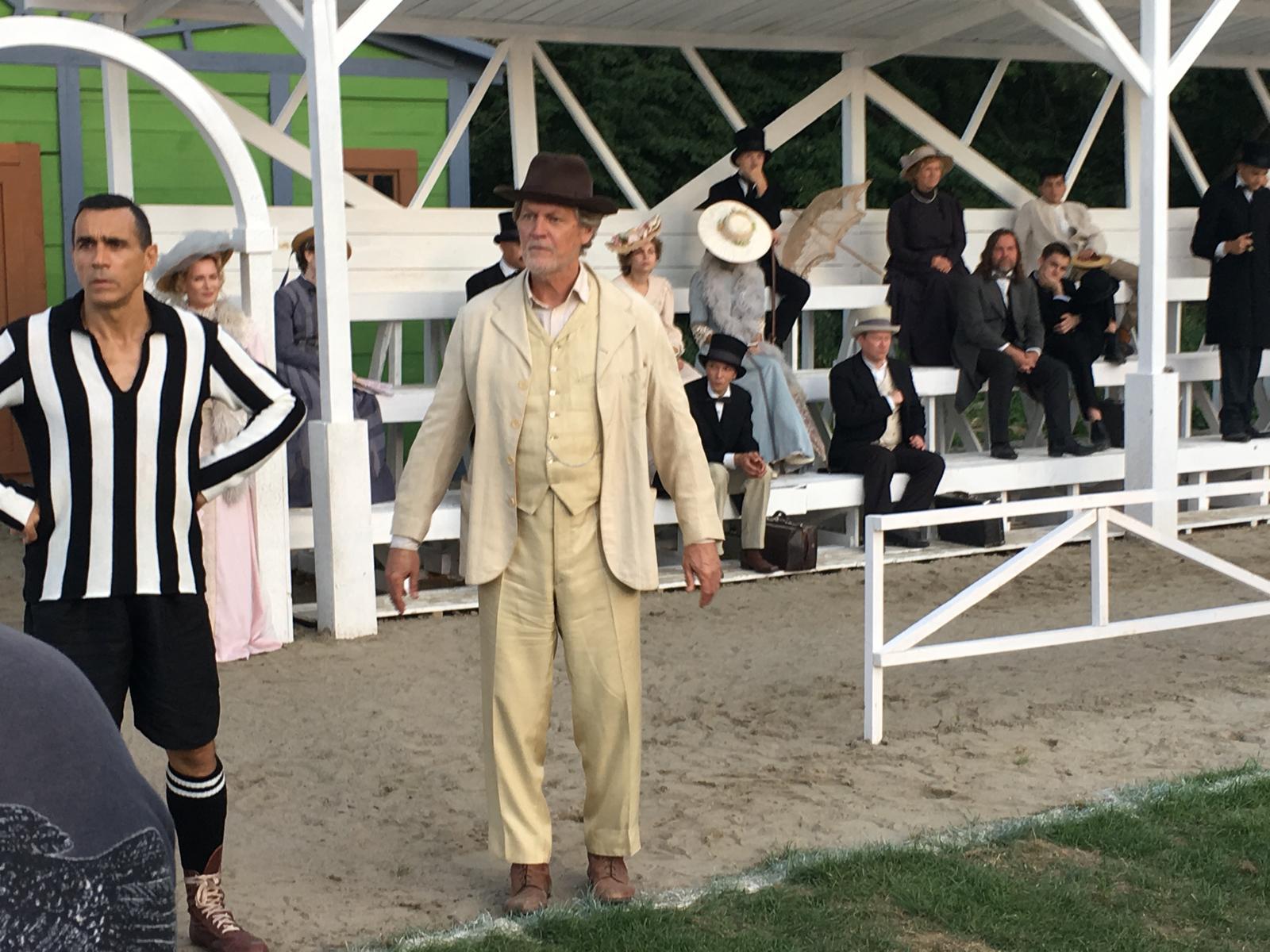
Unfortunately i wasn’t involved in the choreography, but did get to write myself into a scene on the pitch sidelines since my character wasn’t the soccer pro. I do remember when we were waiting to film i kicked the leather soccer ball numerous times tin the goal for about an hour. A totally different feel to the synthetic balls of today since the leather ball is heavier. The next day My hip flexors were in such pain i could hardly walk.
Everyone, even football players ( not soccer, I’m English:)have a weakness. Betting was Parker’s weakness that he couldn’t let go of and that is always interesting to play.
Oh great, that’s right, pin it on me….Its always great to play the character who has flaws, even interesting heroes are only interesting when you know their flaws. You go along with their journey to see if they can overcome them.
Personally, i have always traveled to various countries and found the areas that were comfortable to stay, whether they were ex pat communities or not. But i think Parker wasn’t necessarily into an expat community, he was more like me, a loner who isn’t afraid of new places, people and situations but made his own way and grasped his own opportunities when they were presented to him.
It sucked.(smile) I wanted to continue the role. But that wasn’t how it was written yet I am thankful that he was the instigator of everything that happened next. Even if he wasn’t there.
The gritty criminal element is a constant in this piece. I have always tried to researched eras when I was fortunate enough to be plunged into a historical or period drama. Life back then was not all computers, ai and internet. Life was different and probably a little harder, so to play the authenticity of period in a country that had was in turmoil was interesting.
That goes back to the same question as how to balance your time between actor and producer. Both the historical and commercial aspects are important. But as a viewer you are watching a piece of entertainment, not a documentary, therefore when you create something like the English coach it not only has to be historical it has to be entertaining, in order for it to be commercial.
The timing of this is good because there maybe a lot of people who are not familiar with football but will be engaged in the hype around the world’s biggest sport. It’s like when you watch a certain type of show you want to see more of the same if you are engaged or interested in it. Or if you are fan of a certain type of film then you tend to be drawn to similar pieces of entertainment.
Actors get thrown into situations that they normally wouldn’t be facing , they can be cast as arch enemies, lovers, friends, comrades etc but screen chemistry is not something you can formulate with technique. Screen chemistry can happen even between enemies. It is an underlying vibration that you can’t put your finger on. Sometimes it just happens. Luckily William was a super nice man and always fun to work with and I think we worked together well on the piece. So you be the judge whether there relationship worked.
Currently, I am one of the founding members of a new Production company called Consortium and surrounded with some very talented professionals. We are constantly trying to figure out the balance between the creative and the commercial aspects of a story. One of the challenges is trying to be practical with a story you want to tell. A script may require a certain location or look to tell that story but if the financing is dependent on choosing a different location because it make financial sense, can you then retool the script to get the story told in another context. Or do you stick to the original idea and hope the film eventually gets made. That’s the biggest challenge between creativity and practicality.
It was fun to work on that. You never know who you get to work with, whether it’s an actor or stuntman. We worked with a couple of guys prior to shooting it, to make sure we got the right people to make the action gritty and believable. Also so that it suited the period. Making that type of action demands repetition and a different type of physical movement because period fights are a little different to modern brawls.